HubSpot’s recently released 2026 State of Marketing report offers one of the clearest snapshots yet of where the marketing industry is heading.
Based on insights from more than 1,500 B2B and B2C marketers around the world, the report makes one thing obvious: AI is no longer an emerging trend in marketing. It has become core infrastructure.
Just a few years ago, AI was mostly viewed as an experimental productivity tool used by a handful of early adopters. In 2026, that has completely changed. According to the report, 86.4% of marketing teams are already using AI in some part of their workflow — from content creation and ad optimization to analytics and operational automation.
What’s especially interesting is that AI isn’t simply making marketing work faster. It’s fundamentally changing how marketing teams operate.
Content production is one of the clearest examples.
In the past, creating a single campaign asset often required long production timelines, multiple approval layers, and significant manual work. Today, AI can generate first drafts, create ad copy variations, structure SEO content, and repurpose assets across multiple channels in minutes. Many teams are already using AI to dramatically increase content output, while AI-powered image and video generation continues to accelerate creative workflows.
Personalization is also evolving rapidly.
According to the report, 93.2% of marketers said personalized experiences led to increased leads and purchases. But personalization in 2026 looks very different from the basic segmentation strategies of the past. Brands are increasingly moving toward behavior-driven personalization, where ads, emails, landing pages, and website experiences dynamically adapt based on real-time customer signals.
Another major shift is happening around search.
As Google AI Overviews and AI-powered search experiences become more common, brands are beginning to rethink traditional SEO strategies. Many teams are now exploring Answer Engine Optimization (AEO) — optimizing content not just for search rankings, but for AI-generated answers and summaries.
This changes the role of brand websites significantly.
Users are increasingly discovering information directly inside AI-generated search experiences before ever visiting a company’s website. That means brands need to rethink not only how they structure content, but also how they establish authority, clarity, and relevance within AI-driven discovery environments.
At the same time, the report also highlights the growing pressure marketing teams are facing.
ROI measurement remains one of the industry’s biggest challenges. Teams are expected to produce more content with fewer resources, while platform complexity and competitive pressure continue to increase. Many marketers cited workload growth and burnout as major concerns.
What’s notable, however, is that most marketers do not see AI as a replacement for human teams.
Instead, they see it as a collaborative layer that enhances execution speed and operational efficiency. In fact, 73.4% of respondents said they believe AI will work alongside marketers rather than replace them entirely.
The biggest takeaway from the report is clear:
Marketing advantage in 2026 no longer comes simply from having bigger budgets or better ideas. Paid marketing has become increasingly saturated, CPMs continue to rise, and creative fatigue happens faster than ever.
The brands gaining an edge are the ones building systems that allow them to produce, test, learn, and optimize faster than competitors.
That’s also why AI-powered creative workflows are becoming increasingly important.
The future of marketing is not simply about “using AI.”
It’s about how effectively companies integrate AI into the way their marketing organization operates every day.
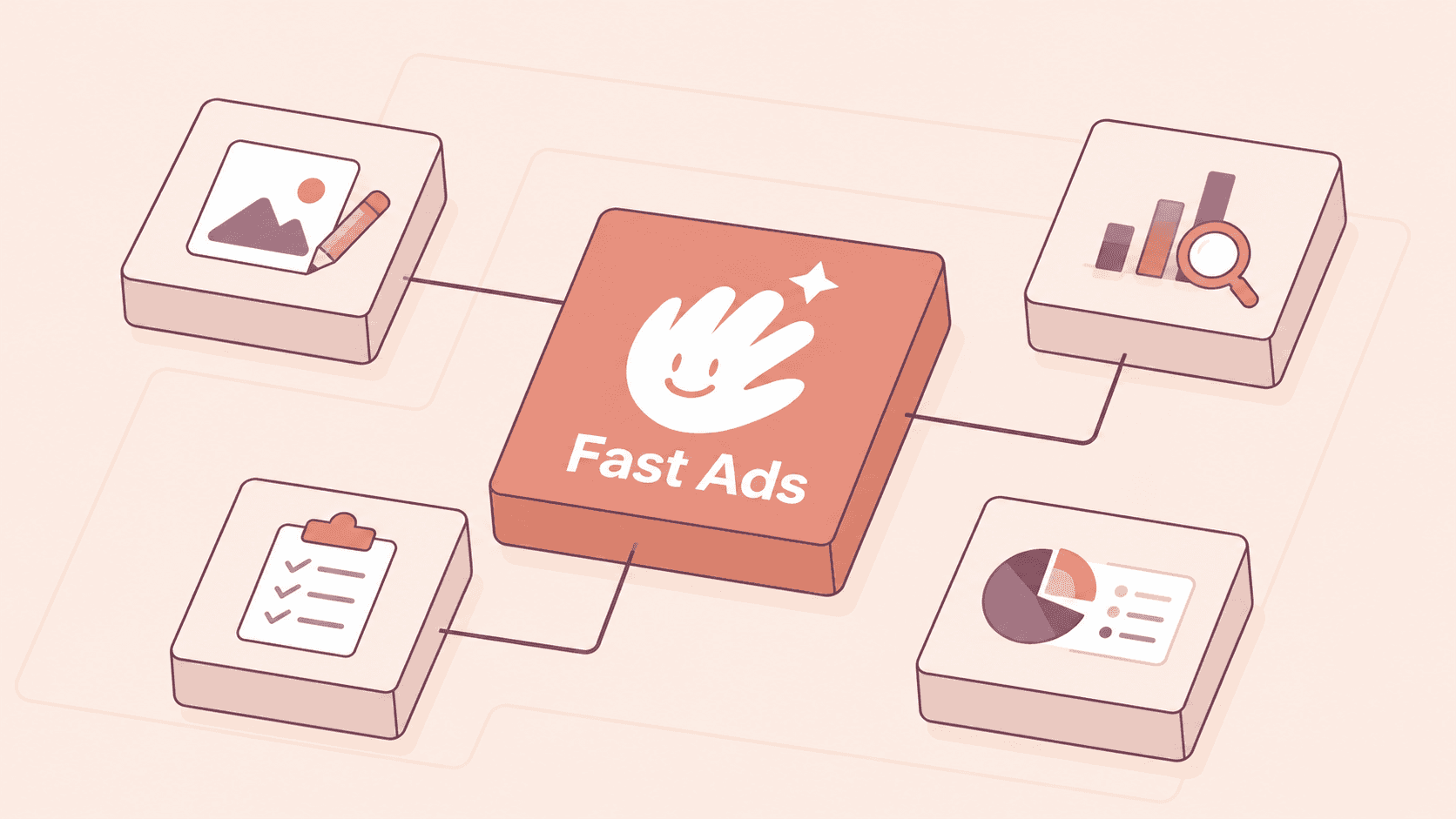
Fast Ads is not simply about adding another AI tool into the stack. It focuses on integrating AI agents directly into the operational structure of modern marketing teams.
Fast Ads automates the most repetitive and time-consuming parts of the ad creative workflow. More importantly, it analyzes advertising performance data to identify which messages, formats, visuals, and CTAs are actually driving results — then connects those insights directly into the next stage of creative production.
In other words, Fast Ads is not just a tool for generating ad creatives faster. It functions more like an AI-powered creative operations system that connects the entire workflow: performance analysis → creative direction → asset generation → testing → optimization.
With a single input, teams can generate campaign-ready creatives across multiple platforms simultaneously, while automatically handling resizing and format variations for each channel. This allows marketing teams to spend less time on repetitive production work and more time on experimentation, learning, and optimization.
Ultimately, the future competitive advantage in marketing will not come from simply “using AI.” It will come from how effectively companies integrate AI into their actual operating workflows — and how quickly they can execute, learn, and improve as a result.

© Suyo, Inc All rights reserved